
Editorial
Steve Holmes · The Villager
Steve Holmes
Editorial · The Villager
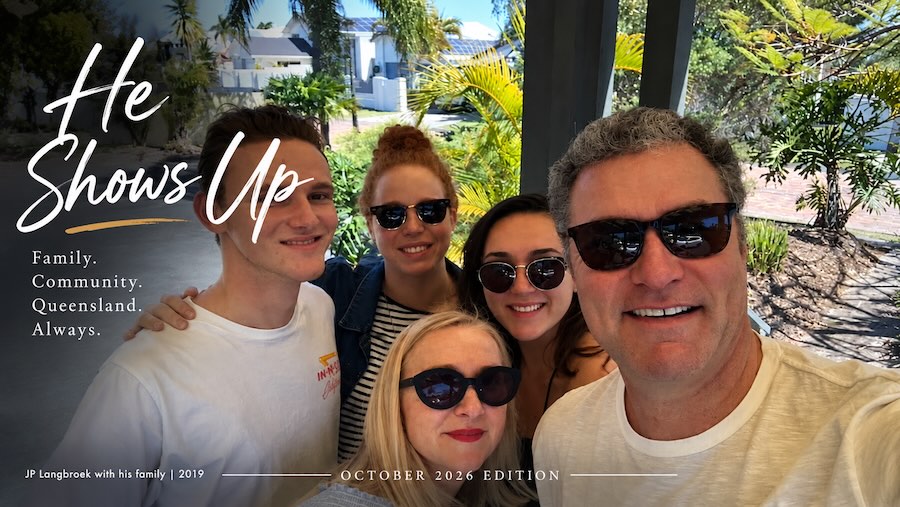
He Shows Up
Every month, among the stories, photographs, notices and pieces that make their way into The Villager, something arrives that we have come to expect.
JP's column.
John-Paul Langbroek has been doing it faithfully for years.
He has sponsored our Community section for several years, helping us communicate and contribute, to tell the stories of the place in which we live.
That may seem small, but its consistency is powerful.
Sometimes I imagine there must be months when the last thing Queensland's Minister for Education and the Arts needs is another deadline from a little community publication in Main Beach.
Yet it arrives.
He shows up.
I hadn't really thought too much about that until I began looking backwards through the life of the man most of us simply know as JP.
Then I realised something, he seems to have been doing it all his life.
Before JP
John-Paul Honoré Langbroek's Australian story began a long way from Main Beach.
He was born in Assen in the Netherlands in 1961.
His father, Jan, was Dutch. His mother, Anne, American.
The family came to Australia the following year.
Jan became a state-school teacher, and teaching took the family through different parts of Queensland. There was Boonah. Later, Burleigh Heads.
Anne sold Avon.
JP would later remember travelling around the Gold Coast with his mother as she made her deliveries.
Anne later worked as a teacher aide at Sunnybank Hills State School.
It is a wonderfully ordinary beginning, from a migrant family finding its place and rhythm in Australia.
A father teaching, a mother knocking on doors, with their children watching on.
Years later, standing in the Queensland Parliament for the first time, JP would thank his parents for something that seems, looking backwards, remarkably important.
They had taught their children self-confidence, independence and importantly aspiration.
And by example, how to retain those things even when well-meaning people around them might discourage them.
Perhaps parents never quite know which of the lessons they teach their children will stick.
These ones seemed to have stuck and served JP well.
The Dentist
JP studied dentistry at the University of Queensland and graduated in 1983.
He worked in Britain before returning to the Gold Coast and building a career here.
For more than two decades, dentistry wasn't something JP had done before politics.
It was who he was.
There is a small memory from his daughter Bronte that tells this part of the story better than a CV ever could.
Dad came home at six every day.
They would run out to meet him as his car came into the garage.
There is something reassuring in the predictability of that image.
Six o'clock, Dad was home.
Then politics arrived and the six o'clock’s changed.
While pulling this story together, I wondered whether JP understood when he first stepped into public life just how much that decision would eventually ask not only of him, but of his family waiting at home.
I suspect like most who live life with such purpose that he did not.
The First Step Wasn't Politics
There is a temptation, when looking backwards at someone who has spent more than twenty years in Parliament, to imagine that politics must always have been the destination.
It wasn't.
JP said that six years of community service through the Surfers Paradise Chamber of Commerce eventually led him towards politics.
I think that distinction matters.
Before he represented a state he worked inside a community.
Before there were constituents, there were patients and community.
Problems that needed solving, people who wanted someone to listen.
Perhaps dentistry and politics aren't as different as they first appear.
When a person sits opposite you with a problem, you listen to them. Then you try to understand what is actually wrong, what the problem actually is.
That’s when you see the truth of their problem and how you can help them solve it.
From family to patients to community then constituents. It’s only the scale that changes.
The First Answer Was No
JP first contested the Surfers Paradise seat in a 2001 by-election.
He lost.
That could easily have been the end of the story. There was already a successful life waiting for him.
Dentistry. Business. Family. Community.
It would have been perfectly reasonable to conclude that politics had given him its answer.
No.
But JP came back.
Three years later, in 2004, he contested Surfers Paradise again.
This time he won.
One of the people he defeated, was sitting independent MP Lex Bell, who happened also to be one of JP's dental patients.
Politics, I think, can be a strange business.
Yet in his inaugural speech, JP publicly acknowledged Bell as an honourable man and thanked him for his service.
That tells me a lot about this man JP.
The Cyclone Arrives
On 18 March 2004, the new Member for Surfers Paradise stood to give his first speech in the Queensland Parliament.
He spoke about his parents, his electorate, his profession, and his family.
He described his wife Stacey as the calming centre of their household.
Then he described himself.
JP, apparently, had a tendency to “descend and depart like a cyclone.”
I like that.
Because by the time we reach the political JP, another description will appear.
Mr Nice.
The cyclone and Mr Nice are the same man.
Perhaps that is our first warning not to mistake kindness for a lack of purpose and drive.
JP also admitted something else that day. He was apprehensive about the adventure ahead.
There was no attempt to rewrite uncertainty as fearlessness. He was apprehensive, and he marched forward anyway.
Courage is as simple as that.
The Dentist Doesn't Disappear
Something revealing happened during JP's first year in Parliament.
The dentist resurfaced.
JP became the first dental surgeon elected to Queensland Parliament since 1938, when John Donnelly, the Member for Wynnum, left Parliament.
Within months, he introduced legislation seeking statewide water fluoridation.
Whether we agree with every policy position JP has taken over twenty-two years is not the point of this story.
What interests me is why he said he was doing it.
His professional qualification, he believed, placed a responsibility on him to use what he knew to improve oral health.
Knowledge created responsibility.
He knew something useful, and he had reached somewhere he could use it.
So he tried.
Years later, another member of Parliament told the story of a waiter named Chris who had once been one of JP's dental patients.
Apparently Chris remained slightly annoyed that JP had entered politics.
He had been forced to find another dentist.
Queensland gained a politician, but Chris had lost his dentist.
Life has a way of keeping grand stories in perspective.
Mr Nice
Five years after entering Parliament, JP became Leader of the Opposition.
The local dentist was now, theoretically at least, an alternative Premier of Queensland.
Politics began demanding more.
But suggestions began surfacing. Was JP too nice for the job?
Politics often rewards theatre, a stage where anger looks strong, aggression decisive.
Yes, theatre at its finest.
JP was encouraged to become tougher. His response was revealing.
Becoming more aggressive for appearance's sake, he argued in substance, didn't make an argument more rational or correct.
That interests me.
Because there is an easy way to survive inside a powerful institution.
Become more like the institution expects you to be. That would be the easiest path.
JP appears to have resisted at least some of that.
The cyclone still had energy.
He simply didn't believe he needed to perform aggressively to prove it.
No Way Back
Becoming Opposition Leader forced a much bigger decision.
Dentistry had remained JP's other life.
His profession, his expertise and his safety net.
It was a time of big decisions. He chose to let his dental registration lapse and dispose of his interest in the family practice.
After more than twenty-five years, the dentist was walking away.
JP said the decision was his, made with the support of Stacey and his family.
That moment matters.
Trying something new while preserving the road home is one thing.
Closing the road behind you is another.
JP had chosen.
Then it was politics’ turn to choose.
It showed him just how unforgiving this stage could be.
There Is No Handbook
Later in 2009, JP said something in Parliament that I suspect applies to far more of life than political leadership.
“There is no handbook for being the opposition leader. You must learn on the job.”
Think about that.
The dentist had spent years learning dentistry. There were textbooks, teachers, examinations, qualifications and established procedures.
Now he occupied one of the most visible jobs in Queensland politics, and there was no manual to guide him.
He spoke openly about managing himself so that the highs did not become too high and the lows too low.
He relied on people with experience he did not yet have.
He specifically acknowledged Lawrence Springborg for his counsel.
There is something worth retaining in that. Leadership isn't always knowing.
Sometimes it is recognising what you don't know quickly enough to learn.
March 2011
Then came the moment I keep returning to.
Campbell Newman wanted to move from Brisbane City Hall into state politics.
For that to happen, the leadership had to change.
JP stepped aside.
Just two years earlier, he had walked away from the profession he had practised for more than twenty-five years.
Now the position that had helped cause him to make that decision was gone too.
He must have wondered, even briefly, whether he had made a terrible mistake.
Perhaps he was angry. Perhaps he wasn't.
Maybe he went home to Stacey and questioned the choices that had brought him to this point.
I don't know, but it’s a very human inflection point when your aspirations are suddenly overtaken by the reality of others.
But I can also imagine JP sitting with the consequences of a decision that no longer looked quite as it had two years earlier.
When reporters came looking for his reaction, JP described politics as a “treacherous business.”
It was part of the job.
Lawrence Springborg lamented that Queensland had missed the opportunity to have JP as its “gentleman Premier”.
And then came the part that interests me most.
JP stayed.
Staying
That may be the easiest part of his story to overlook.
Political stories naturally concentrate on advancement. On winning, leadership and ministerial positions.
But sometimes character is easier to see after that advancement stops.
JP remained.
Then LNP won government in 2012, and he became Minister for Education, Training and Employment.
Three years later, the government lost office.
JP retained Surfers Paradise.
And then he stayed again.
One year.
Two.
Five.
Eight.
Nine.
For almost another decade, there was no ministerial office waiting for him.
There was simply the work, an electorate, parliament, community and the next election.
The People Behind the Machine
There is another clue to JP buried in one of his parliamentary speeches.
At the end of 2009, the Leader of the Opposition stood to thank people.
Politicians thanking politicians is not that unusual, but JP's list kept going.
Parliamentary attendants.
Security staff.
Hansard.
Library staff.
Committee staff.
Catering staff.
Cleaners.
Maintenance workers.
Switchboard operators.
Electorate staff.
The people behind the machinery.
He joked that Hansard had a remarkable ability to make politicians sound better than they actually were.
There is something revealing about who a person notices.
Titles make the visible people very visible.
Character sometimes reveals itself in whether you can still see everyone else.
Eventually JP came back to the people at home.
Stacey, Chloe, Bronte and Piers.
He described his family as his “rock of sanity”, reminding politicians what really mattered.
I thought again about six o'clock.
About a Dad coming into the garage. His children running out to greet him.
The rock of sanity was there well before any titles and accolades of a public stage.
Full Circle
In October 2024, Queensland changed government again.
Twenty years after JP first entered Parliament, he returned to government.
And the son of the state-school teacher became, once again, Queensland's Minister for Education.
This time with the Arts as well.
There is something satisfyingly circular about that.
A boy whose father's profession moved the family around Queensland now carries responsibility for the system in which his father worked.
The child whose American mother took him along while she sold Avon on the Gold Coast now represents part of that same Gold Coast.
The dentist who treated people one at a time now makes decisions affecting people he will never meet.
Life rarely travels in straight lines.
Sometimes, if you stay around long enough, it makes circles.
The Village
And through all of this there is Main Beach.
That isn't something we need to manufacture for this story.
The record stretches back years.
JP has carried Main Beach concerns into Parliament.
He has supported residents over questions affecting The Spit and the surrounding community.
The Main Beach Association has acknowledged his support.
And then there is our own small piece of evidence.
The Villager.
For several years JP has sponsored our Community section.
And edition after edition, he writes his community update.
It would be easy to dismiss that as one of the small obligations of being a local member.
Perhaps it is.
But after looking backwards through his life, I see it slightly differently.
Because there is a pattern here.
The migrant family that found a home.
The dentist who built a practice.
The Chamber member who became involved.
The candidate who lost.
The candidate who came back.
The new MP who brought his professional knowledge with him.
The Opposition Leader who gave up his old profession.
The leader who lost the leadership.
The man who stayed.
The minister.
The opposition MP.
Then, the minister again.
And throughout it all, the community.
He keeps showing up.
Maybe that is too simple.
But I have learned that simple things are often the hardest things to do consistently.
Showing up when everything is going well isn't difficult.
Showing up after someone tells you no is harder.
Showing up when the position changes is harder.
Showing up when there is no title attached is harder again.
And continuing to show up after twenty-two years?
That tells us something.
This Time
Another month has rolled around.
Another edition of The Villager, and another deadline.
As I give JP’s story its final polish, Claire and I are sitting in the back corner of a business suite, in the deep recesses of a Taipei hotel.
And, as usual, somewhere among everything arriving for October will be JP's contribution.
He doesn't know I have written this story.
I wanted it that way.
For years, JP has helped us tell the stories of this Village and wider community.
I thought it was time the community told one of his.
So when JP eventually sits down with the October edition of The Villager, perhaps expecting to find the familiar collection of people, places and happenings from around Main Beach, he will discover something he wasn't expecting.
Himself.
And perhaps he will wonder why.
The answer is actually quite simple.
JP, you showed up.
Again.
And again.
And again.
I notice simple things like that.
We all do.
The Cost of Fun
A Villager Asks a Question Worth Answering
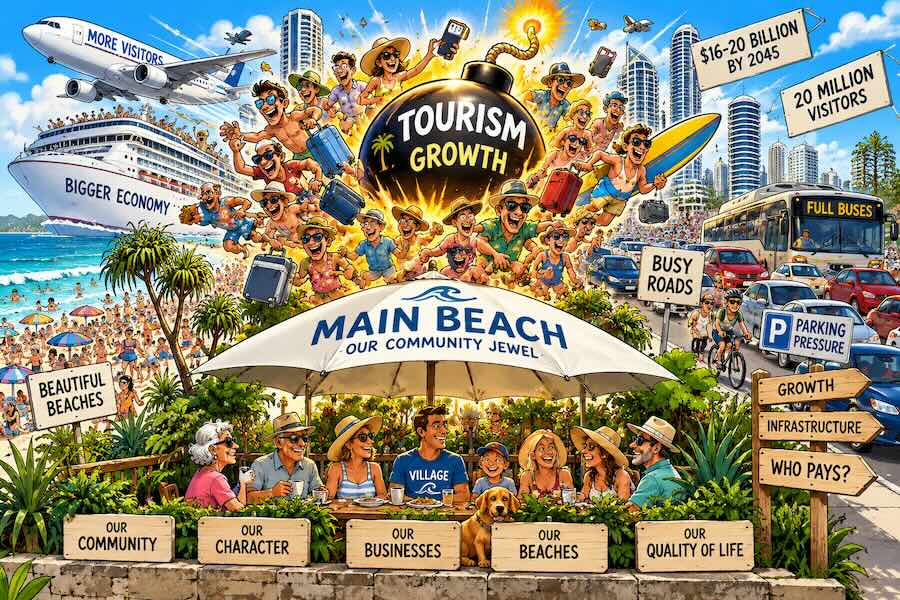
A successful tourist city must also remain a successful place to live.
Tourism is an important part of the Gold Coast's identity and economy. It creates jobs, supports businesses and brings visitors from around the world to enjoy everything our city has to offer. This article was inspired by Richard Holliday's recent commentary on Professor Edmund Goh's article entitled "Locals can pay a price for success in tourism" published by the Gold Coast Bulletin 12 October 2026.
But as our city looks towards an ambitious future of tourism growth, an important question deserves consideration: how do we ensure that the communities who call the Gold Coast home continue to enjoy the very qualities that make it such a wonderful place to live?
For those of us living in Main Beach, the relationship between tourism and community life is particularly important.
We are fortunate to live in one of the Gold Coast's most beautiful neighbourhoods, surrounded by beaches, parklands, waterways and attractions that draw visitors throughout the year.
Those attractions contribute to the vibrancy of our city. They also bring challenges that residents experience in very practical ways.
Traffic congestion, parking pressures, crowded public spaces and the demands placed on local infrastructure are all part of the conversation.
As tourism continues to grow, it is reasonable to ask whether the infrastructure and services supporting our communities will grow alongside it.
The question is not whether tourism should succeed. Of course it should.
The question is how we balance that success with the everyday needs of the people who live here.
Growth and liveability should not be competing ambitions.
A thriving visitor economy and a thriving residential community can, and should, exist together.
Achieving that balance requires thoughtful planning, meaningful community consultation and a commitment to ensuring that the benefits of tourism are shared.
It also requires us to recognise that a destination's appeal is shaped by more than its attractions.
The character of its neighbourhoods, the quality of its public spaces and the wellbeing of its residents all contribute to what makes a place special.
Main Beach is a community, not simply a destination.
As the Gold Coast plans for its future, that distinction deserves to remain firmly in view.
Our thanks to Richard Holliday and Professor Edmund Goh for contributing to the broader discussion about tourism growth and its relationship with our community.
Cholangio News
CHOLANGIOCARCINOMA FOUNDATION AUSTRALIA
Building Connections Across Borders – A Special Visit to Taiwan
There is something very special about bringing people together who share the same passion for improving the lives of those affected by cholangiocarcinoma (bile duct cancer), no matter where in the world they may be.
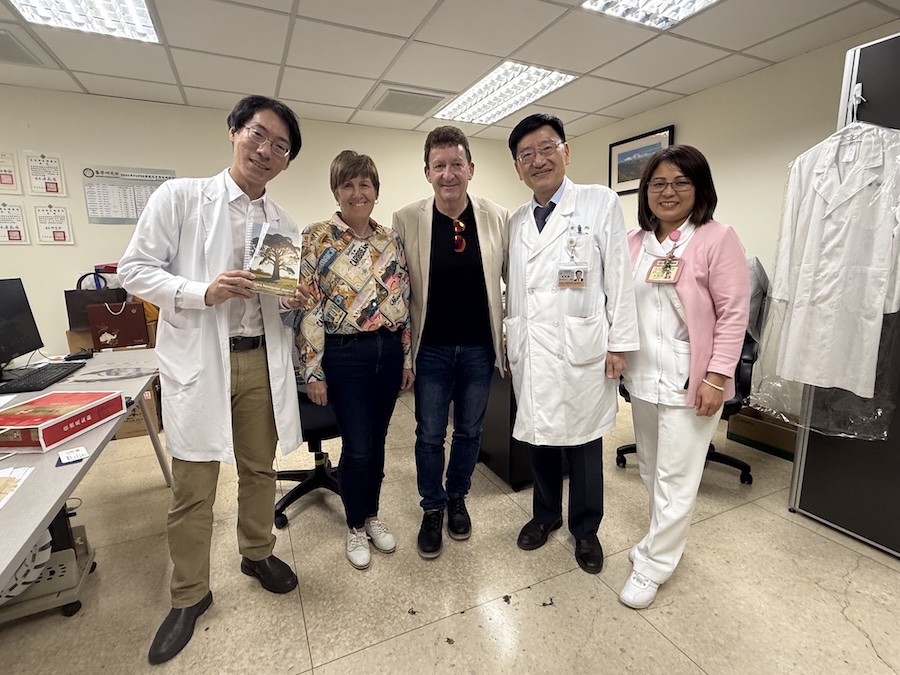
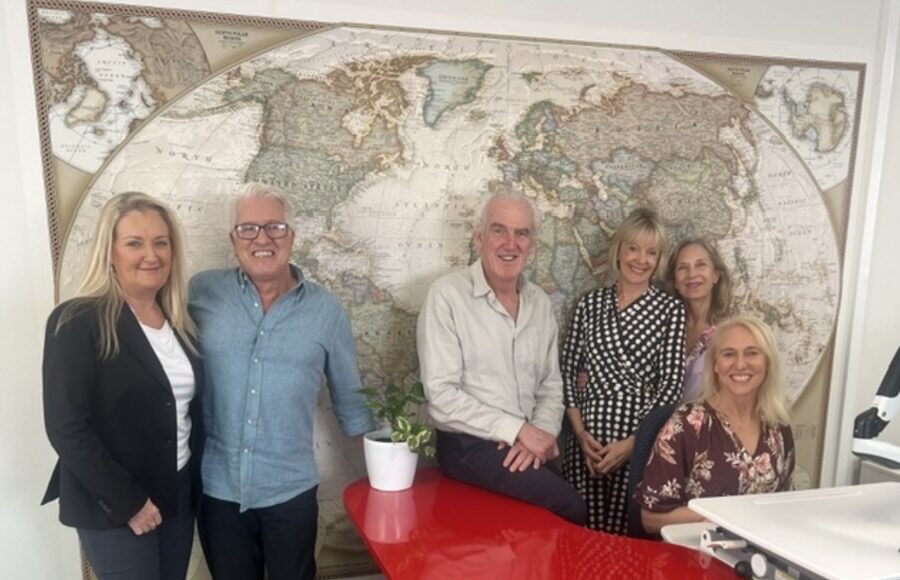
During their recent visit to Taipei, Taiwan, our Foundation's co-founders, Steve and Claire Holmes, had the wonderful opportunity to visit the Taipei Veterans General Hospital Research Centre, where they were warmly welcomed by Professor Yi-Hsiang Huang and his colleagues.
Professor Huang is the Director of the Department of Medical Research and President of the Taiwan Liver and Biliary Patients’ Association. His dedication to liver and biliary disease research and patient support made this a particularly meaningful meeting.
Steve and Claire spent a lovely afternoon with Professor Huang and his team, sharing conversations about cholangiocarcinoma, the importance of research, and the experiences of patients and families facing this challenging diagnosis.
The hospitality extended to them was exceptional. Professor Huang and his colleagues were incredibly generous with their time, making Steve and Claire feel genuinely welcome. It was an afternoon filled with warmth, mutual respect and a shared desire to make a difference.
For our Foundation, opportunities like this are about much more than visiting a research centre. They are about building relationships, exchanging knowledge and strengthening connections between the medical and patient communities across international borders.
Cholangiocarcinoma may be a relatively rare cancer, but the challenges faced by patients and families are shared worldwide. By connecting with dedicated professionals and organisations such as Professor Huang and the Taiwan Liver and Biliary Patients’ Association, we continue to build a stronger global community.
Our sincere thanks to Professor Huang and his wonderful colleagues for their kindness, generosity and warm Taiwanese hospitality. Steve and Claire returned from the visit with great appreciation for the time spent together and the connections made.
It is a lovely reminder that, wherever we are in the world, we are united by a common purpose — ensuring that no one faces this diagnosis alone.
Warm regards,
Jill Brown
Health & Wellbeing
Sonali Johri
The Climate Behind a Beautiful Cup
I used to drink Merlo’s Organico Coffee Blend, but recently a friend recommended the PNG Blend. I tried it, loved it, and realised how much climate can shape the taste of coffee.
There is a particular pleasure in tasting a coffee that feels brighter, smoother, and more alive than the one before it. That difference may begin long before roasting or brewing—in cool mountain air, rainfall, and the slow rhythm of the growing season.
Coffee is a remarkably sensitive crop. It does not simply need warmth; it needs the right kind of warmth. In the tropical highlands of the Bean Belt, days are warm but not scorching, while nights are cool. Arabica coffee, prized for its nuanced flavour, generally prefers temperatures around 18–21°C. Too much heat can rush the cherries to ripen, leaving less time for the sugars, acids, and aromatic compounds that make a cup taste complex and alive.
Altitude plays a leading role. Higher farms experience cooler air, misty mornings, and slower ripening. That slowness is a gift: it gives the bean time to develop depth, sweetness, gentle acidity, and vivid fruit notes. In Papua New Guinea’s Highlands, for example, the cool conditions help create the smooth, layered character I noticed in the PNG Blend.
Rain matters just as much. Coffee plants need moisture to flower, set fruit, and swell their cherries, but they also need a pause. A dry spell followed by rain can prompt flowering, while prolonged wetness may delay ripening, damage roots, or encourage fungal disease. Farmers read the weather closely, because a season’s rainfall shapes both the size of the harvest and the character of every bean.
As the climate warms, these finely balanced conditions are becoming harder to maintain. Rising temperatures, unpredictable rain, pests, and disease threaten both yields and flavour. So the next time a coffee tastes exceptional, consider it a small act of climate, care, and patience—captured in a cup.
Disclaimer - Article written through ai research.
Inside the Dish
John Naismith · Gluten Free Kitchen
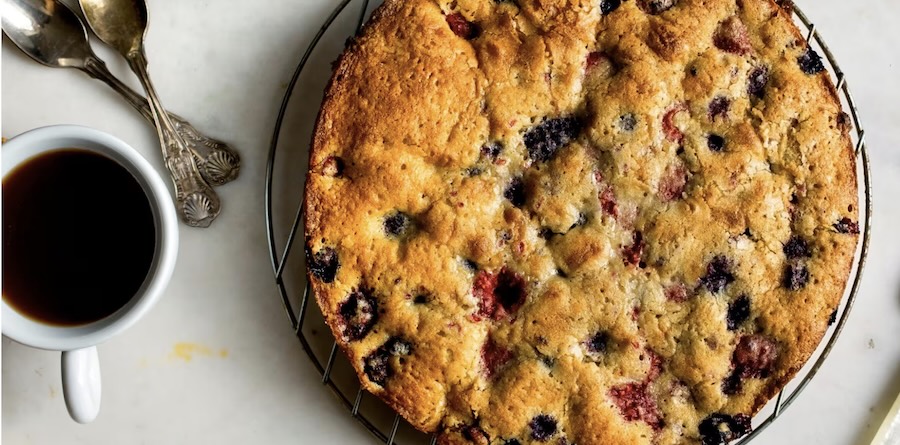
Summer Berry Cake
Soft, fluffy and packed with juicy berries, with a little crisp sugar crust on top.
I make mine with a mild olive oil, which keeps the cake moist. If you do not like olive oil, use melted butter.
Ingredients
- 90 ml olive oil or 100 g melted butter
- 80 g caster sugar
- 2 eggs
- 170 g Greek yoghurt
- 1 tsp vanilla extract
- 200 g plain flour (can use GF flour, of course)
- 1½ tsp baking powder
- Pinch of salt
- 250 g blueberries
- 250 g raspberries
- 100 g blackberries
- 15–20 g caster sugar, for sprinkling
Method
- Preheat oven to 180°C.
- Line a 20 cm round tin or springform tin.
- Whisk the eggs and sugar until light and fluffy. Whisk in the olive oil, then stir in the yoghurt and vanilla. Fold in the flour, baking powder and salt, then gently fold in the berries. Don’t overmix.
- Pour batter into the tin, sprinkle with the sugar, and bake for around 45 minutes, until a skewer inserted comes out clean.
- Let the cake rest for 15 minutes before removing.
I bought myself an Avanti Digital Kitchen Thermometer, so useful for cakes, meat etc. and only $14/$15.
Enjoy!
Surf Club News
Southport Surf Life Saving Club
A Fantastic Start to the Surf Life Saving Season
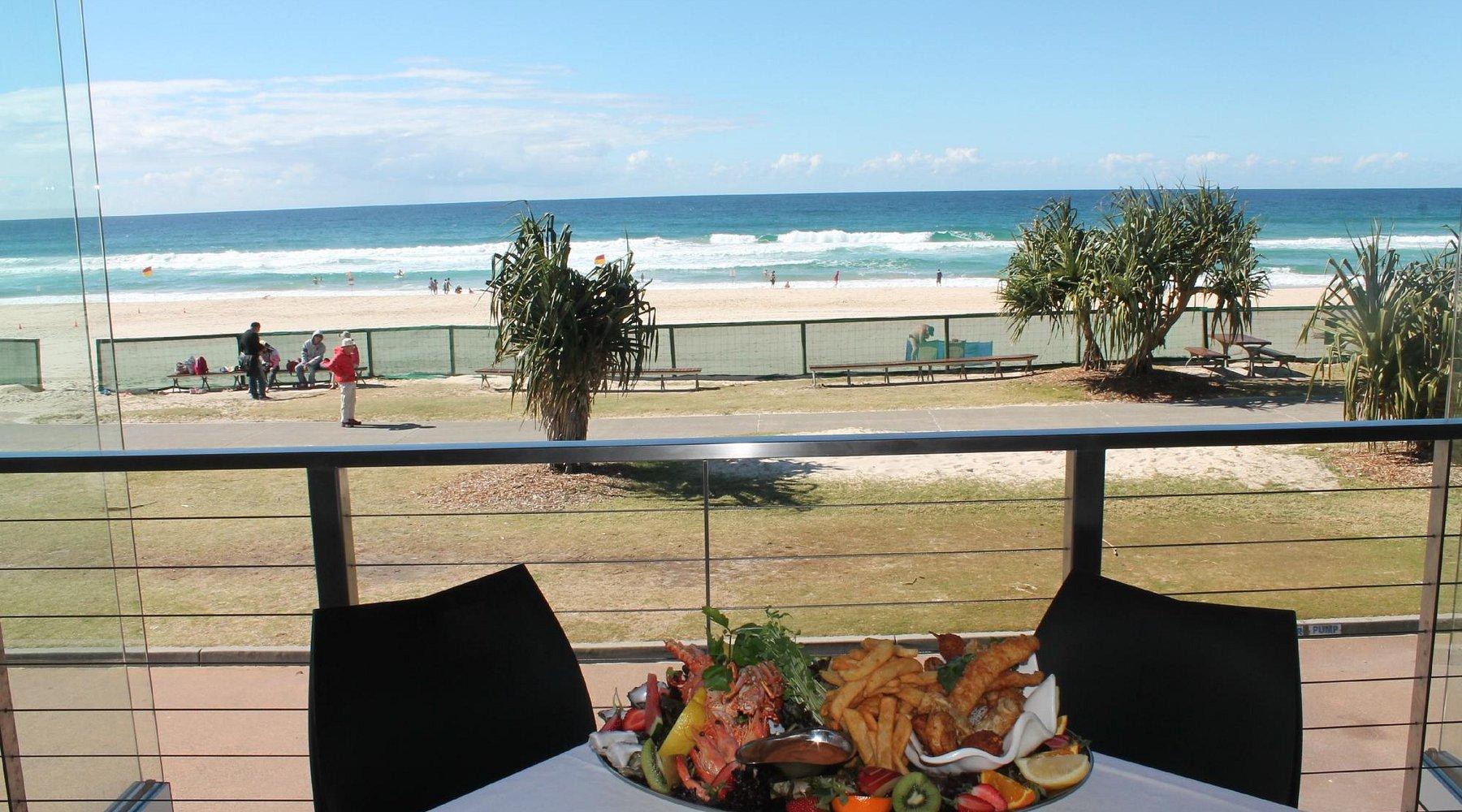
Dear Mainbeachers,
What a fantastic start to the new Surf Life Saving season we've had at Main Beach, with a record number of Nippers joining our Club this year!
It's wonderful to see so many young families getting involved and particularly pleasing to see the next generation of Lifesavers beginning their journey with us. Our Nippers program is already one of the largest on the Gold Coast, and this year's record registrations are something we can all be very proud of.
Of course, a program of this size doesn't happen without an enormous amount of work behind the scenes, so a big thank you to all our volunteer age managers, coaches, parents and everyone involved in making it happen. With our volunteer Lifesavers also back on weekend patrols, the beach is once again a hive of activity as we head towards summer.
Back at the Club, we've continued to enjoy strong support from members and visitors, and with the warmer weather returning, there's no better place to catch up with friends and enjoy everything Main Beach has to offer.
Melbourne Cup Day is just around the corner, and this year we're making it easier than ever to enjoy a great day out without spending a fortune. Our $120 package for two includes a choice of four mains, starter and dessert, a bottle of one of our favourite-selling wines and a glass of bubbly on arrival. That's just $60 per person for a fabulous day at the Club, so why not grab a friend, get dressed up and join us? Tickets are selling fast so make sure you book early to avoid missing out!
Our Monday night Chef Specials also continue to be a huge hit, with members enjoying 50% off these delicious meals. If you haven't tried them yet, you're missing out — and at those prices, why would you cook?
Or if you're just looking for a fun night out without spending a fortune, why not join us for our Wednesday night Trivia? It's free to play, kicks off at 6.30pm and there are some great prizes up for grabs. Bring a few friends, test your knowledge and enjoy a good laugh along the way!
As we head towards what promises to be another busy summer, it's lovely to see Main Beach continuing to thrive. Whether you're joining us for breakfast at the Pavilion, a meal in the Clubhouse or simply catching up with friends over a drink, we always appreciate your support.
Thank you to our members, our hardworking staff and especially our wonderful Surf Life Saving volunteers who give so much of their time to our community.
Your continued support of the Club is what helps make all of this possible, providing the funding needed to keep our Lifesavers on the beach and our Nippers program growing. So, whether you're joining us for a meal, a drink or one of our regular activities, you're helping support something pretty special here at Main Beach.
Stay safe and always remember to swim between the flags.
Wine Club News
Gold Coast Wine Club
October Luncheon at Videre Restaurant
Our September luncheon was fabulous, and wow, it's October already!
Remember our big Christmas luncheon is on Friday, 4 December. Wear Christmas gear and bring a $20 gift for Kris Kringle.
Our next luncheon is at the fabulous Videre Restaurant at Royal Pines, Carrara, on Friday, 30 October. The cost is $135 per person. Please register and pay as soon as possible.
Hi everyone,
We are looking forward to sharing a great year of celebrating with good friends, new and old. There's no better way than sharing fabulous food and wines at the incredible Videre Restaurant, Royal Pines (Ross Street, Carrara).
Bookings close on Thursday, 22 October, so please register and pay before then.
We register at midday and continue until 3.30pm.
The cost is $135, which includes a course lunch with sparkling, white and red wine.
There will also be lucky door prizes as well as raffle prizes, so please bring some cash for this.
I'd like to welcome Brad Nankervis as our wine representative from Domaine Wines. Brad supplied us with some great French wines at our September luncheon.
Please confirm your booking and pay into the Gold Coast Wine Club account as soon as possible.
Due to restaurant regulations, there are no refunds or credits after Thursday, 22 October.
Please email me at jpoidevin1952@gmail.com to confirm names and any dietary requirements. No changes to the menu will be made on the day.
Also add all names to your payment.
Regards,
Julie Poidevin
President
Community Updates
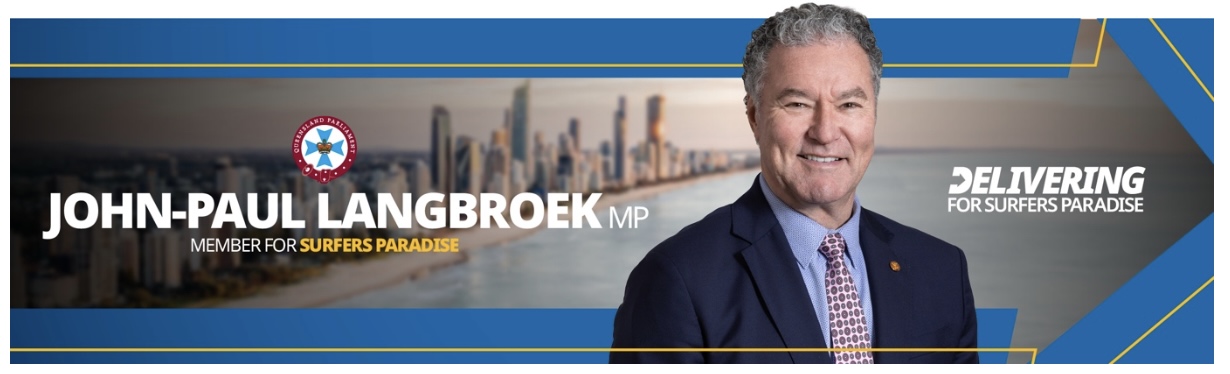
Sponsored by The Hon. John-Paul Langbroek MP
The Hon. John-Paul Langbroek MP
Member for Surfers Paradise
Facebook · Instagram · X (Twitter) · LinkedIn
Dear subscribers,
The Gold Coast 500 is now less than a week away, and I want to again thank Main Beach residents for their patience in dealing with road closures and access restrictions in the lead up to and during race weekend.
I want to also remind you about my Breach of Bail, Go to Jail message last month. To recap, after hearing from Queenslanders, the largest changes to bail laws in Queensland’s history will look like:
- A new offence created for committing a significant crime while out on bail for an Adult Crime, Adult Time offence
- The new offence will carry a minimum mandatory sentence of 12 months to be served in custody
- It will apply for youth who commit an Adult Crime, Adult Time offence while on bail
- It will also apply to adults who commit an Adult Crime, Adult Time offence, a child sexual offence, or the domestic violence offence of coercive control while on bail
I still want to hear what constituents think about the changes we’ve introduced, and I encourage you to have your say and complete my survey, if you haven’t already, by clicking here.
Construction is now underway on our election promise of a new world-class marine wildlife hospital at Sea World. The sod-turning took place earlier this month and the facility is expected to open next year.
A reminder that my office is an authorised drop-off location for two great charities. DV Safe Phone receives old or unwanted working mobile phones to help empower domestic violence victim-survivors across Australia. Computers 4 Learning refurbishes old technology for low-income families, students, and job seekers. You can donate working or non-working laptops, desktop computers, monitors and related peripherals. Both charities have donation boxes in my office foyer.
If you have any concerns about local issues, you can contact my office via email surfers.paradise@parliament.qld.gov.au or call us on 5600 2100. My social media accounts are also a great way to keep updated with electorate news, so I welcome you to connect via Facebook, Instagram, X, and LinkedIn.
Best wishes,
The Hon. John-Paul Langbroek MP
Main Beach Community Board
Macintosh Island v GC500 – Wildlife Safety
As you all know, Macintosh Island is used by tens of thousands of visitors each year. It’s such a wonderful place for families and friends who can watch and feed the birds, ride their bikes, walk the tracks or enjoy a BBQ.
But who actually takes care of this fabulous park? And what happens to the wildlife when the GC500 comes to town? The answer is, of course, the City of Gold Coast, but more importantly, it’s the wonderful team of caretakers led by Mark, the unofficial “Mayor of Macintosh Island”.

Many of you have shared concerns over the years, asking what happens to the wildlife, in particular the peacocks, when the V8 Supercar races are on.
From my catch-up with Mark before last year’s race, I learned that special attention is given to the birds before, during and after the event by the team of caretakers.
They work on a rotational basis from 5am to 5pm each day and increase attention to safety and feeding times. Additional fencing is installed with the help of Supercars to corral flightless birds and their babies, and feed them in specific areas away from the general public several times a day.
The swans, geese and other water-loving birds are herded into the fenced pond, and specialised monitoring of the birds’ activities, in particular any unhatched eggs, is conducted throughout the day.
Not surprisingly though, Mark told me the hardest ones to keep an eye on were the male peacocks. He said they absolutely love the attention given by racegoers and will often fly up on top of the stage or speakers, displaying their magnificent plumage for all to see.
He said they are true “show ponies”, who have learned how to keep themselves out of harm’s way over the years.
I asked one of the caretakers recently what was the best thing we can do as a community to keep the animals safe. His response was simple. He asked us to educate visitors to our beautiful community, not just during the V8 event, but throughout the year, about Macintosh Island and the wildlife.
The current team are true ambassadors of Macintosh Island who deserve our appreciation and admiration for the work they do, not just during October, but all year round.
Written by Mez Robson
Please follow the Friends of MacIntosh Island Facebook page for more community updates and information.
A Photo Opportunity Waiting to Happen
Two Strangers, One Beautiful Moment
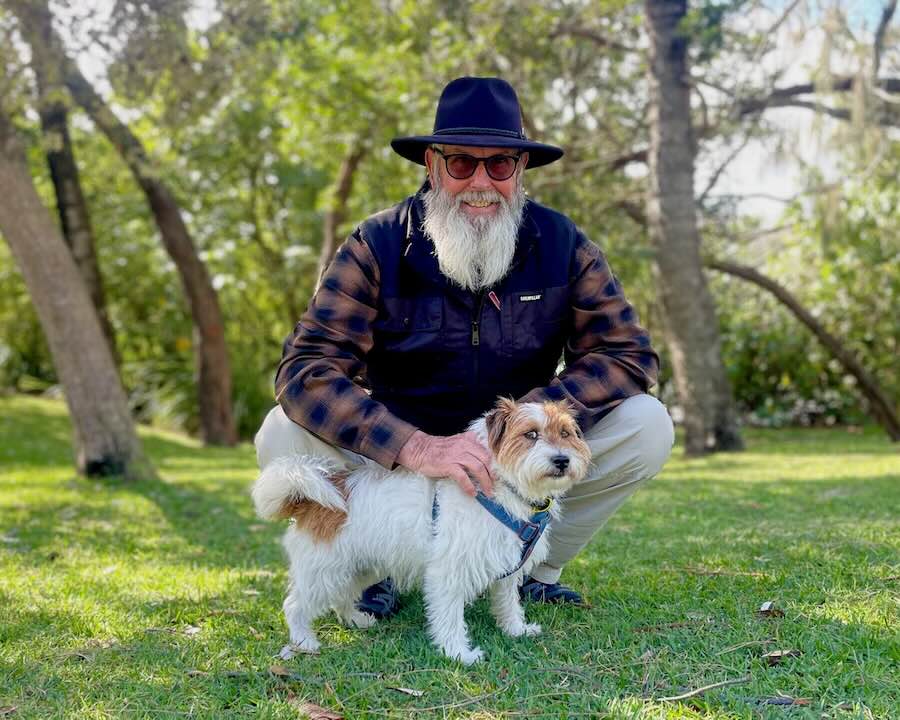
I was walking in “Peacock Park” on Macintosh Island when I spotted them — a man with the most magnificent beard and hat, and his little dog. The artfulness of what I saw literally stopped me in my tracks. They were just so interesting, such wonderful characters.
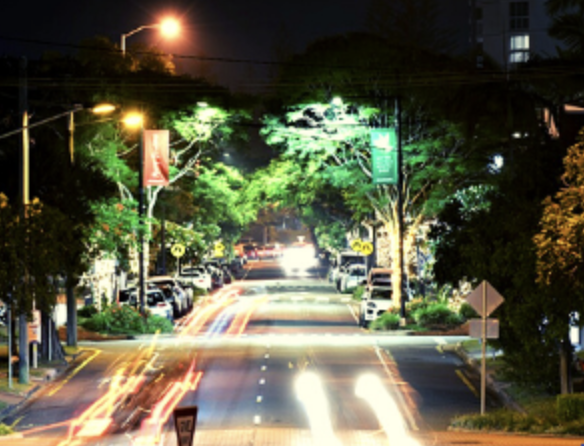
I couldn’t resist. I walked over and asked if I could take a photo. “Sure,” he said with a smile.
The backdrop of the park offered the perfect setting and the man obligingly squatted down with his dog. I pulled out my iPhone and clicked the camera button, never imagining just how delightful that captured moment would be!
Look at that little dog! Him standing so proudly, looking straight at the camera. It’s as if he knew exactly what was happening. And his human, so beautifully dressed in his casual attire. What a presence! Kind eyes, the incredible beard, and that warm, genuine smile.
This is what I love about having the eyes to see, really see: two strangers, enjoying an ordinary day in the park. And yet, to my eyes, I saw the extraordinary beauty of the moment.
Beauty comes in many forms — this day, it was a man and his dog in the park.
Love Sofia
The Local Scene
Showcasing Main Beach Businesses
Main Beach Travel – Now “Travel Call”
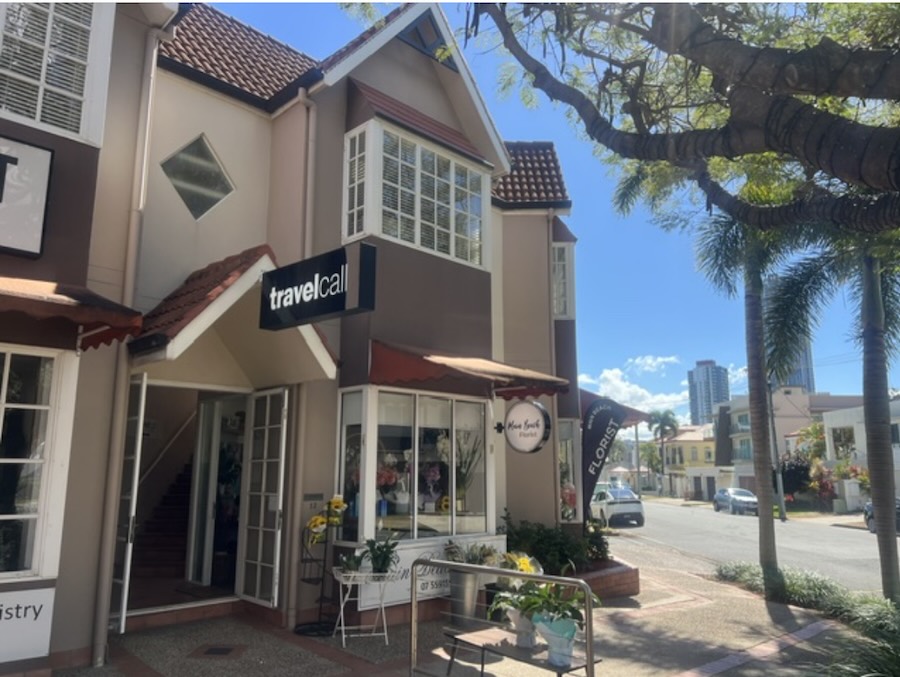
Living in Main Beach Village, we are indeed fortunate to have so many quality hospitality and other businesses owned and operated by Main Beach locals.
Main Beach Travel (MBT), located at the northern end of Tedder Avenue and recently renamed Travel Call (TC), is no exception, being owned and operated by locals Mike and Mandy Dwyer.
The travel service, which opened on 1 January 2000 with two staff (Mike plus one other) in the location that is now home to Main Beach Florist, has come a long way. Now with twenty-eight staff, and having weathered the Y2K bug, 9/11, the Ansett collapse and the GFC, MBT/TC is recognised as one of, if not THE leading travel agencies in Australia, word of mouth being the biggest driver.
Specialising in leisure travel, after eighteen years in operation, Main Beach Travel was invited to become a Virtuoso Member, limited to the top 1% of travel agencies. Client benefits of being looked after by a Virtuoso Member include upgrades from hotels and cruise lines, plus value-added benefits including, when travelling as a client of Travel Call, receiving a classic Virtuoso Member VIP welcome, as well as food and bar credits.
A recent (2026) travel award saw Travel Call/Main Beach Travel recognised as Australia’s best individual cruise agency by CLIA (Cruise Lines International Association), based on quality and volume. A good reason includes the two Cruise Masters on staff specialising in helping clients make the most of their cruise experiences.
In any business, having good people around (and appreciative clients) is the way to ensure success, and Main Beach Travel has both. Long-serving staff include three members who have been with the agency for over twenty-five years, with over half being with MBT for over ten years. It goes without saying, but I will: “Good staff make for good travels!”
Apart from general airline business, cruising and hotels, Travel Call specialises in independent travel (IT), i.e. fully planned tours including travel, hotels, restaurants, excursions and local highlights, making for a well-planned, fully rounded itinerary.
Whilst Main Beach Travel/Travel Call offers an excellent service to Main Beach Villagers, their reputation is increasingly bringing travel clients from all over Australia, including Sydney, Brisbane and especially Melbourne, a city that sure has an affinity for our Gold Coast.
Africa, cruising, Antarctica and adventure travel are increasing in demand, although unsurprisingly Europe is still the main destination, with growing trends including “multi-generational” travel — families including grandparents — and also “skip-generation” travel, where grandparents take their grandchildren away on adventure holidays.
Call in and have a chat. You are assured of a friendly welcome, and a very special travel experience may well be your outcome.
Local Knowledge
Beach Restoration Update
Alfred Took It. Trud R Brings It Back.
Trud R: The Big Boat That Gets the Job Done
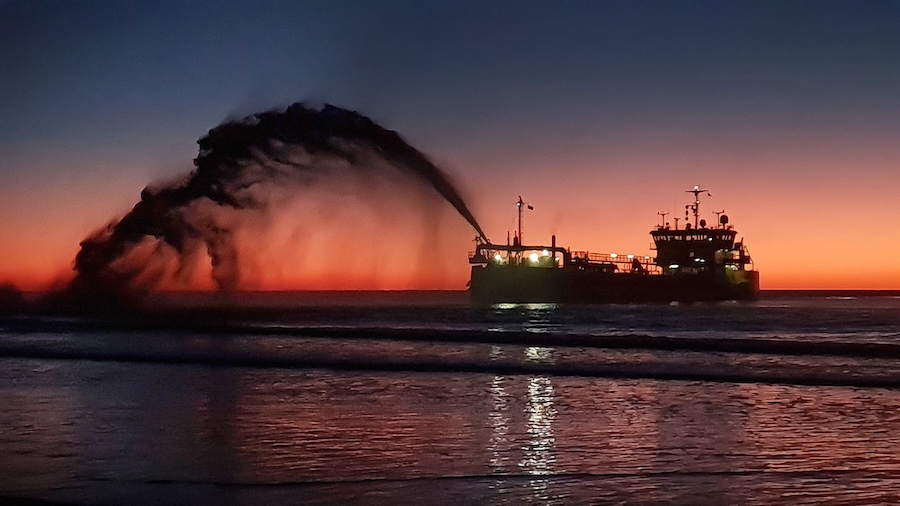
She sucks. She sprays. She moves mountains of sand. And she's helping keep our beaches where they belong.
If you've spent any time looking out from Main Beach, chances are you've seen her. A large industrial ship sitting just beyond the breakers, moving slowly along the coastline, sometimes appearing to do very little.
Then suddenly, the show begins. An enormous arc of sand and seawater shoots through the air, rising above the ocean before falling back towards the coast. Not quite a fountain, not quite a fire hose.
But that changes when at night under a bright moon and then against our spectacular Main Beach sunrises, its display becomes quite extraordinary. An armchair show for residents and visitors alike.
We stop and we watch and for a few moments an industrial operation becomes beachfront theatre.
Meet Trud R, the hardworking dredging vessel that has become one of the Gold Coast's more unusual offshore attractions.
She's not really here for your entertainment, although she does provide it. She's here because Tropical Cyclone Alfred left our coastline with a serious problem, and Trud R has been helping put it right ever since.
Alfred Took It. Trud R Brings It Back.
When Cyclone Alfred battered the Gold Coast in March 2025, the damage wasn't limited to fallen trees, flooded streets and disrupted businesses. The ocean had been busy too, with powerful waves stripping enormous quantities of sand from our beaches, cutting into dunes and leaving sections of the coastline exposed.
For a city built around its beaches, that's not a small problem. The sand beneath our feet is more than somewhere to lay a towel or build a sandcastle. It forms part of a natural protective barrier, absorbing wave energy and helping shield the dunes, parks, roads, homes and businesses that make up our coastal community.
When the sand disappears, so does part of that protection.
The challenge was straightforward enough to describe, but considerably harder to solve. The Gold Coast needed enormous quantities of sand returned to its coastal system, preferably without sending endless convoys of trucks through the streets.
Enter Trud R, a specialist dredging vessel with a deceptively simple assignment.
Find sand. Move sand. Put sand where it can help.
The ingenuity lies in how she does it.
A Floating Vacuum Cleaner With a Very Big Belly
Trud R is a hopper dredger, a vessel designed to collect, transport and discharge large quantities of sediment. Think of an enormous floating vacuum cleaner with a cargo hold instead of a dust bag, capable of carrying its collected material across the water.
Her work begins beneath the surface, where dredging equipment gathers sand from the seabed. Sand and water are brought aboard, with the sand retained in the vessel's hopper before being transported to a designated placement area.
Instead of relying on hundreds of trucks to carry sand along our roads, the vessel moves it by sea, using the ocean itself as the transport route.
Once she reaches her destination, the sand can be discharged into the water at a selected location. Some dredging operations also use a spectacular technique called rainbowing, projecting a powerful mixture of sand and seawater through the air towards the placement area.
It's the kind of engineering that can look almost theatrical from the shoreline, particularly when the spray catches the light.
No tickets, no reserved seating, and usually a pretty good view from Main Beach.
But behind the spectacle is a serious piece of coastal engineering. Every load represents sand being moved from somewhere it has accumulated to somewhere it can help restore or protect the coastline.
And when you consider the quantities involved, the scale of the operation becomes almost difficult to imagine.
The Numbers Are Almost Ridiculous
When we first wrote about Trud R in May 2025, she was helping repair the damage Alfred had left behind. We thought she was impressive then.
She's been rather busy since.
In 2026, Trud R returned for another major Gold Coast beach replenishment campaign. Between April and October, the City reported that the vessel completed 1,156 deliveries, moving approximately 1.2 million cubic metres of sand.
To appreciate that volume, imagine an Olympic swimming pool filled not with water, but sand. Now imagine approximately 480 of them lined up along the coast.
That's roughly the amount of sand moved during this year's operation alone.
Across the broader Gold Coast recovery program since Cyclone Alfred, almost three million cubic metres of sand have reportedly been returned to the coastal system, equivalent to approximately 1,200 Olympic swimming pools.
It's an extraordinary amount of material, and an equally extraordinary response to the damage left by a single weather event.
Where Did All That Sand Go?
The City's reported 2026 figures give us some indication of how the operation was distributed along the coastline.
- Miami and Mermaid Beach: 797,740 cubic metres
- Surfers Paradise: 231,164 cubic metres
- Main Beach: 36,702 cubic metres
These figures represent reported allocations within the wider operation, but they also reveal something about the scale of the challenge. The sand wasn't simply being delivered to one damaged beach. It was being distributed across different parts of the Gold Coast according to their recovery needs.
And closer to home, Trud R has been performing another useful service.
At the Gold Coast Seaway, sand naturally accumulates around the entrance, potentially reducing water depth and making navigation more difficult for boats entering and leaving the Broadwater.
The dredger has been helping remove that accumulated material. By September, surveys showed approximately 45,000 cubic metres less sand within the dredging area, although natural sand movement may have contributed to the change.
Much of the dredged sand was relocated offshore near Main Beach, keeping valuable material within the coastal system rather than removing it altogether.
It's a rather clever double act.
Clear the channel. Keep the sand in the coastal system.
Boats benefit from improved navigational access, while the coastline retains material that can contribute to its natural sand reserves.
Not bad for a vessel that, to the casual observer, appears to spend much of her time wandering slowly around offshore.
But Where Is All the Sand?
This is the question I suspect more than a few villagers have asked.
If Trud R has been moving mountains of sand, why doesn't Main Beach suddenly look several metres wider?
The answer lies beneath the waves.
We tend to think of a beach as the visible strip of sand between the dunes and the water's edge. But the beach doesn't end where the water begins. It continues underwater, across a gently sloping seabed that forms part of the same constantly moving coastal system.
That underwater landscape matters enormously.
As waves approach the shoreline, the depth and shape of the seabed influence how they behave. In suitable locations, adding sand offshore can help waves break farther out, reducing some of the energy reaching the beach and dunes.
Think of it as rebuilding the beach's shock absorber.
The sand doesn't have to be visible beneath your feet to be doing something useful.
And there's another benefit. During calmer conditions, waves and currents can gradually move some of that offshore sand towards the shoreline, helping replenish the visible beach.
Trud R doesn't have to place every grain exactly where it will eventually finish. She helps restore the supply of sand, and the ocean continues moving it.
Of course, the same ocean can take sand away again. That's the nature of living beside a dynamic coastline, where beaches are constantly being reshaped by waves, currents, tides and storms.
Coastal protection, therefore, isn't a one-time repair. It's an ongoing relationship between natural forces and the engineering we use to manage their consequences.
The Quiet Business Behind the Big Show
The City estimates that Gold Coast beaches contribute around $3.4 billion annually to the local economy. That includes the tourism, accommodation, restaurants, retail and events supported by one of Australia's most recognisable coastlines, along with the broader appeal of living beside the ocean.
It's easy to admire the beaches for their beauty and forget that they are also essential infrastructure.
Unlike a road or bridge, however, this infrastructure moves.
Storms remove sand, waves transport it along the coast, and currents redistribute it across the seabed. Much of this movement is natural, but when severe weather strips away large quantities of sand, the resulting loss can expose the coastline to further damage.
That's where vessels such as Trud R become valuable.
The wider recovery program following Cyclone Alfred has involved substantial investment from government, including support from the Australian and Queensland governments. Trud R is one of the most visible parts of that response, although the complete program involves considerably more than dredging alone.
In October 2026, the City reported that its beach restoration program had received recognition through a coastal engineering award for excellence.
Not bad for a ship whose most memorable party trick involves throwing sand and seawater through the air.
But awards and impressive volumes are only part of the story. The real measure of the work is what it contributes to the coastline and how that coastline performs when the next storm arrives.
And What About the Next Storm?
There is an important distinction between restoring sand and making a coastline storm-proof.
Trud R helps replenish the sand supply and strengthen the coastal buffer, but she cannot prevent storms, nor does placing sand offshore automatically rebuild every damaged dune.
Narrowneck and other vulnerable sections of our coastline still present difficult questions about long-term protection. These are places where natural sand movement, engineered structures and future storm conditions all need to be considered.
What the dredging program can do is improve the amount of sand available within the coastal system, helping it absorb wave energy and recover from future erosion.
That's the practical achievement.
Not simply replacing what Alfred took, but helping the coastline respond when the next major weather event arrives.
For a city whose identity, economy and lifestyle depend so heavily on its beaches, that is work worth doing.
The Star Leaves the Stage
After months of work, Trud R was preparing to leave Gold Coast waters in October, her latest assignment nearing completion.
There would be no farewell concert, fireworks or final bow. Just another job completed and another destination waiting.
I rather like that about her.
She's not particularly elegant in the conventional sense. She's certainly not quiet when the machinery gets going, and her idea of putting on a show involves industrial equipment, enormous quantities of sand and an ocean-sized stage.
But there's something satisfying about watching a machine built for a purpose actually fulfil it.
We live in a world full of announcements, campaigns, promises and presentations. Trud R offers something refreshingly different. She turns up, performs the work she was designed to do, and leaves something useful behind.
And perhaps that's what makes her such an appealing character in our little village.
Most visitors who see her offshore will never know how much sand she has moved, what a hopper dredger does or why placing sand underwater can help protect a beach. They'll remember the enormous ship and, if they're lucky, the spectacle of sand and seawater rising above the ocean.
But the next time you're walking along Main Beach, look beyond the breakers and remember what was happening out there.
The ship may have gone, and the spectacular arcs of spray may have disappeared, but some of the sand she delivered remains beneath the water and along our coastline, helping protect the place we call home.
Trud R. She doesn't advertise. She just executes.
And it's what she leaves behind that matters.